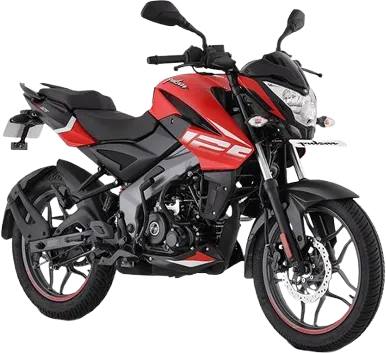
Engine Displacement: 124.45 cc
The Pulsar NS125 is powered by a high-revving 124.45 cc, single-cylinder, 4-stroke, air-cooled, SOHC 4-valve engine. Unlike the 2-valve configuration found in many entry-level commuters, the 4-valve head allows for better breathing at higher RPMs, providing a more spirited performance.
Max Power: 12 PS @ 8500 rpm
The NS125 delivers 12 PS of power. This output is optimized to be punchy in the low and mid-range, making it an excellent "street fighter" for navigating through dense urban traffic while feeling significantly lighter than its larger NS siblings.
Max Torque: 11 Nm @ 7000 rpm
Generating 11 Nm of torque at 7000 rpm, the NS125 provides a consistent pull. The engine tuning emphasizes agility, allowing riders to maintain momentum without constant gear hunting in city conditions.
No. of Cylinders: 1
The motorcycle utilizes a single-cylinder configuration, which minimizes frictional losses and keeps the machine compact. This layout is crucial for maintaining the bike's sharp handling characteristics inherent to the NS (Naked Sports) series.
Valve Train: SOHC, 4-Valve
The use of a 4-valve head is a standout feature in the 125cc segment. It enables more efficient intake and exhaust gas flow, resulting in a more responsive throttle and cleaner combustion, which is essential for meeting BS6 emission norms.
Fuel System: Electronic Fuel Injection (FI)
The BS6-compliant NS125 uses an advanced Fuel Injection (FI) system. This ensures optimized fuel-air mixture delivery under varying temperatures and altitudes, which significantly improves cold-start reliability and overall fuel efficiency.
Top Speed: 103 km/h
The Pulsar NS125 reaches a top speed of approximately 103 km/h. While not built for high-speed touring, its gearing is perfectly suited for city riding, offering excellent pull through the first three gears.
Mileage: 50–55 kmpl (Real-world)
While ARAI-certified figures are often higher, real-world usage in Nepalese urban environments typically yields between 50–55 kmpl. The FI system plays a key role in squeezing the most out of every liter of fuel.