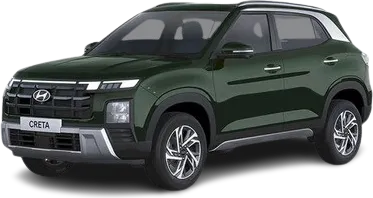
Displacement: 1,497 cc (Petrol) / 1,493 cc (Diesel) / 1,482 cc (Turbo)
The 2026 Creta offers a versatile engine lineup. The 1.5L MPi Petrol is designed for smooth city driving, while the 1.5L U2 CRDi Diesel remains the choice for long-distance mileage seekers. For performance enthusiasts, the 1.5L Turbo GDi Petrol delivers a class-leading 160 PS of power.
Max Power: 160 PS @ 5,500 rpm (Turbo Petrol)
The Turbo Petrol variant is the most powerful in its segment, producing 160 PS. The naturally aspirated petrol and diesel engines produce 115 PS and 116 PS respectively, ensuring a balanced range of options for different driving styles.
Max Torque: 253 Nm @ 1,500–3,500 rpm (Turbo Petrol)
With a peak torque of 253 Nm available from as low as 1,500 rpm, the Turbo Creta offers effortless acceleration. The Diesel engine follows closely with 250 Nm, providing excellent lugging power for highway cruising.
No. of Cylinders: 4
All engine options in the Creta lineup feature a 4-cylinder architecture. This ensures superior refinement and lower vibrations compared to 3-cylinder counterparts found in some rival SUVs.
Valve Train: DOHC
The Double Overhead Camshaft (DOHC) system with 4 valves per cylinder optimizes air intake and exhaust, enhancing fuel efficiency and high-speed engine performance.
Fuel System: GDi (Turbo) / MPi (Petrol) / CRDi (Diesel)
The Turbo variant uses Gasoline Direct Injection (GDi) for maximum efficiency, while the standard petrol uses Multi-Point Injection (MPi). The Diesel employs a Common Rail Direct Injection (CRDi) system for precise high-pressure fuel delivery.
0-100 km/h: ~8.9 Seconds (Turbo DCT)
The Turbo Petrol variant paired with the 7-speed DCT is the sprinter of the group, hitting 100 km/h in under 9 seconds. The Diesel and NA Petrol variants focus more on linear progression, taking approximately 10.5 to 12 seconds.
Top Speed: 180 km/h
The Creta is capable of reaching a top speed of roughly 180 km/h in its Turbo and Diesel guises, though it is engineered for stability and comfort at Indian expressway limits of 100–120 km/h.